What happens between grades matters across a school too.
ClassMap brings teacher-led classroom observations together so schools can see how participation, engagement and student development change across classes, cohorts and time.
An observation recorded during the lesson — the same input teachers already use in the classroom.
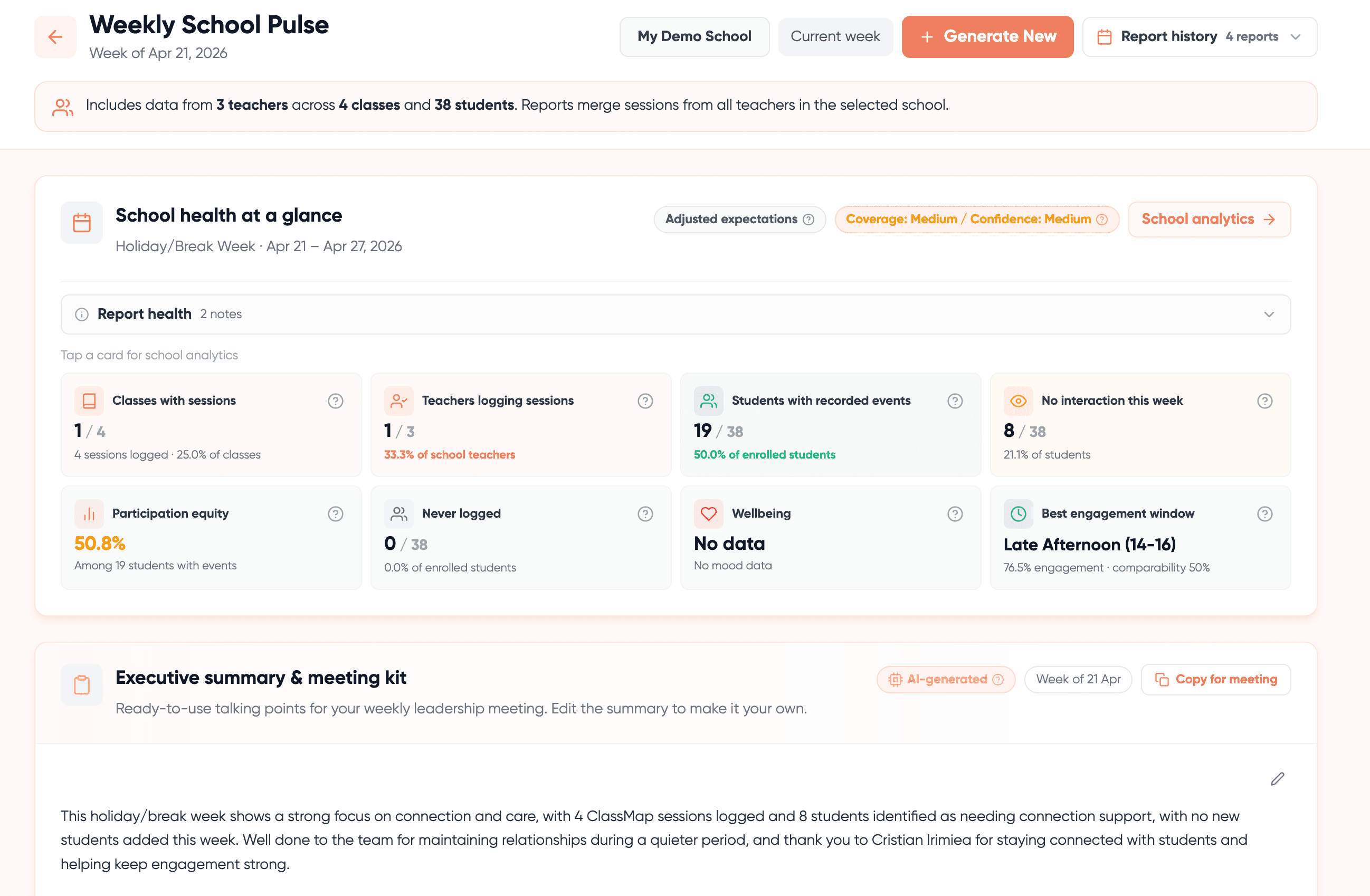
Connected across classrooms, teacher-entered observations become School Pulse.
School visibility starts with what teachers actually see.
Every observation in ClassMap starts with a teacher. ClassMap connects those observations across lessons and students. Across multiple classrooms, they can form a broader picture of what is happening across a school.
- 1
Teacher observation
A teacher records what she notices during a lesson.
- 2
Student
Observations attach to each student's record.
- 3
Class
Repeated observations describe the class over time.
- 4
Cohort
Patterns can be compared across a year group.
- 5
School
Connected context gives leadership a school-level view.
School-level insight is not generated by monitoring students. It is built from structured observations teachers enter during their classroom work.
From classroom observations to School Pulse.
School Pulse brings teacher-led classroom observations together so leadership can review patterns across classes, cohorts and time.
- Class-level patterns
- Cohort patterns
- Participation and engagement
- Teacher-observed wellbeing context
- Observation coverage
- AI-supported summaries for human review
See where a closer look may be useful.
School Pulse does not flag students or classify risk. It shows where the recorded context is changing — so people can decide what deserves attention.
A class shows a sustained change in recorded participation or engagement over time.
A cohort looks different from other comparable groups.
Similar teacher-entered observations appear repeatedly.
A student's classroom context changes across several lessons.
ClassMap surfaces the recorded context. Teachers and school staff decide what it means and what, if anything, should happen next.
Useful when leadership needs more than end-of-term results.
Situations where connected classroom context helps school teams.
Pastoral review
Bring recorded classroom context into conversations about students who may need a closer look.
Year-group review
See whether changes are isolated to one class or appear more broadly.
Teacher conversations
Use shared classroom context as a starting point for discussion.
School improvement conversations
Review patterns across time rather than relying only on occasional snapshots.
Parent or support meetings
Bring relevant recorded classroom context into the conversation where appropriate.
School visibility only works if the classroom workflow works for teachers.
ClassMap is built around teacher-entered observations during everyday lessons. A school implementation should begin small enough to test whether teachers actually use the workflow — and whether the resulting context is useful.
Lightweight classroom workflow
Observation capture should fit into normal teaching practice.
Value back to teachers
Teachers should get useful student and class context from what they record.
Visibility emerges from use
School-level data becomes meaningful only when there is enough consistent classroom activity.
Start small. Evaluate what is actually useful.
A school pilot is designed to test fit — not to promise outcomes.
Suggested scope
60 days
Enough time to build recurring classroom context.
3–10 teachers
A focused group rather than immediate school-wide rollout.
Selected classes or year groups
Keep the initial scope understandable.
What to evaluate
Teacher adoption
Are teachers actually using the workflow?
Observation coverage
Is enough classroom context being captured to make the picture meaningful?
Teacher usefulness
Do participating teachers find value in the context they receive back?
School visibility
Does School Pulse give leadership information they consider useful?
Implementation fit
What needs to change before a wider rollout?
Built from real classroom use.
ClassMap is already used by teachers in everyday lessons. These figures describe usage — not promised outcomes.
Usage figures, not evidence of improved attainment, wellbeing or workload.
Visibility without classroom surveillance.
ClassMap has no sensors and no ambient monitoring. School-level views exist only because teachers choose what to record.
School-level views are built from information teachers enter during their classroom work. AI-supported reports and recommendations remain subject to human review. ClassMap does not independently diagnose students or decide what support they need.
Teachers observe. People interpret. People decide.
One system, from classroom moment to school-level context.
ClassMap starts with the teacher's classroom workflow. School visibility is what becomes possible when that context is connected across classrooms.
See what teacher-led classroom context can reveal across your school.
Start with a focused pilot and evaluate whether the workflow and resulting School Pulse are useful for your teachers and leadership team.