When AI Does the Homework, Who Does the Learning?
An essay arrives with a clear argument, well-chosen evidence and a neat conclusion. On the page, it looks like a success. But ask the student why they left out a particular source, or what made them change their mind, and another part of the work comes into view: the decisions behind the prose.
Teachers have always had to infer understanding from incomplete evidence. Generative AI makes that harder. It can produce fluent work without the student practising the reasoning the assignment was designed to develop. Yet a polished essay is not evidence of AI use, either. The challenge is to find out what a student understands without treating fluency as proof, or suspicion as a method.
This is an assessment question before it is a technology question.
When better work does not mean better learning
Take-home work has never been a perfect window into a student's thinking. Parents help, classmates talk and tutors explain difficult concepts. Teachers have always interpreted the result with some knowledge of that context. Generative AI changes the scale of the problem: substantial parts of an answer can now be produced in seconds, with little visible trace of how the student arrived there.
The OECD Digital Education Outlook 2026 distinguishes between performing a task with AI and learning enough to do it independently. Its review of emerging research warns that when AI takes over the cognitive work, the final product may improve while the underlying knowledge or skill does not. A stronger submission does not necessarily mean a stronger grasp of the subject.
Think of a student who recognises a correct algebraic solution when it is shown to them but cannot explain why the second step works. The answer on the page is accurate. Their understanding may still be fragile, and a final grade alone is unlikely to reveal that distinction.
What happens when the help disappears?
A 2025 study published in Proceedings of the National Academy of Sciences offers a concrete example. Researchers studied nearly 1,000 high-school mathematics students in Turkey. Some students had access to a general-purpose AI assistant during practice. Others used a more constrained AI tutor, while a control group worked without either tool.
Students with AI assistance performed better during practice. But when they later completed an assessment without the tools, the group using the general-purpose assistant scored about 17% lower than the group that had practised without AI. The more constrained tutor did not show the same statistically significant decline in independent performance. Importantly, it did not produce a statistically significant improvement on that independent test either.
The result needs context. The study took place in one subject, with a particular group of students and particular AI tools. It cannot predict what every classroom will experience. But the gap between success during practice and performance without assistance is precisely the gap that schools need to understand.
Some students appeared to use the assistant to get answers rather than work through the problems. The concern goes beyond factual errors in AI output: a correct answer can still leave a student without the practice needed to solve the next problem alone.
The value of working something out
The untidy middle of learning rarely makes it into a gradebook. A student rereads a paragraph, tries a method that fails, hears a classmate's objection and realises their explanation needs work. None of these moments looks much like achievement in isolation. Together, they show a learner testing ideas rather than simply presenting an answer.
Of course, difficulty is not a teaching strategy on its own. A student stuck for too long needs help, and a clear explanation can save time that would otherwise be wasted. Good support makes the next attempt possible; it does not make the attempt unnecessary.
Teachers see fragments of that process in questions, false starts and revisions. The finished assignment usually hides them.
What authentic learning can still look like
Imagine a history discussion in which a student insists that one event explains the outbreak of a war. A classmate points to a source describing tensions that had been building for years. The student returns to the evidence and adjusts the argument. The teacher has seen the student reconsider a claim in real time, something the final essay might never show.
Sometimes the evidence is quieter. A maths student circles the line where their calculation went wrong. A writer removes a confident claim after realising they cannot support it. A child who struggled last week explains an idea to someone else. None of these moments guarantees lasting understanding, but together they offer teachers more to work with than a finished page.
Conversations, drafts, independent explanations and the ability to apply knowledge in a new situation can sit alongside formal assessment. Each offers a different angle on what a student knows. The value comes from seeing how those pieces fit together over time.
None is a perfect measure. A quiet student may understand more than they can easily say aloud. A confident speaker may still hold misconceptions. The context matters, and one observation should never become a permanent label.
Schools do not have to bring AI into the classroom to respond to it
Students encounter generative AI at home, in search results and through friends, regardless of whether their school uses it. Teachers should not have to guess what help is permitted on a take-home task, and families should not have to guess either. Schools can make those expectations clear while preserving opportunities for students to read, write, reason and practise independently. Work completed in a classroom, where a teacher can see part of the process, may tell a different story from a polished project submitted after a weekend at home.
Whether to introduce AI tools into lessons is a separate decision, with practical consequences. Access varies between families. Student information may be sensitive. Age suitability matters, as does the extra work a new tool can create for teachers. Choosing not to use generative AI in a classroom can be a considered educational decision, rather than a reluctance to change.
UNESCO's guidance on generative AI in education and research calls for a human-centred approach, including attention to privacy, age-appropriateness and institutional responsibility. A school does not need to treat adoption as inevitable to take those concerns seriously.
The things teachers notice still matter
A grade tells us how a task went. It cannot capture every change along the way: the student who came back to a problem after giving up, the quiet pupil who finally asked a question that moved the discussion forward, or the child who can now explain an idea that baffled them a week ago. Such observations are easy to forget in the pace of a school day. They gain meaning when a teacher can revisit them, compare them with later work and hear the student's own account.
At ClassMap, we have explored why student progress does not always fit in a gradebook. The arrival of generative AI makes that idea even more relevant. When a finished assignment is easier to produce than ever, the human context around it becomes more valuable: what the student attempted, what they understood, where they needed help, and what changed over time.
Teachers already carry more than enough administrative work. Capturing every hesitation or question would add noise, not insight. What matters is leaving room for professional judgement and having a practical way to remember the observations that are worth returning to.
What should education protect?
Public debate often treats schools as either enthusiastic adopters of AI or institutions resisting change. Teachers know the choices are more complicated than that. A school might discuss how generative AI works, set boundaries around its use and still decide that some learning should happen entirely without it. Those decisions belong to the school's educational purpose, not to a technology trend.
An excellent piece of work deserves recognition. So does the thinking that produced it: the false starts, the revisions, the ability to explain an idea tomorrow without the original help. If schools see only the finished answer, they risk missing the part of learning that takes the longest to build.
At ClassMap, we believe those small observations deserve a place alongside grades and assignments. They help teachers see the learner behind the work, especially when the work itself no longer tells the whole story.
Related Articles
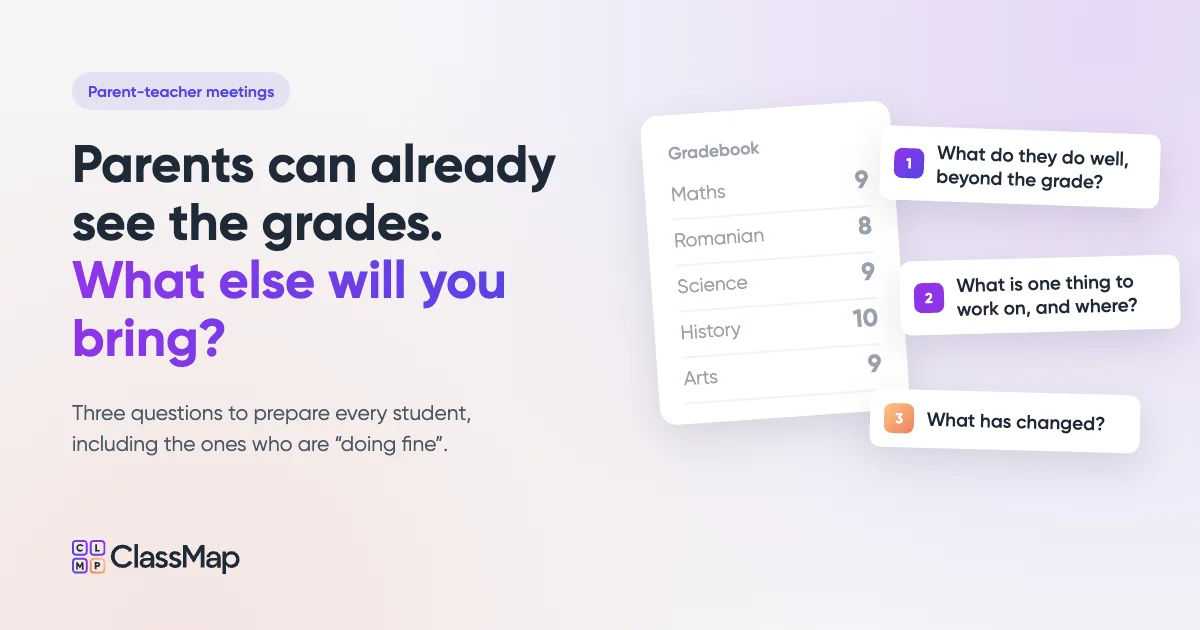
Parents can already see the grades. What else will you bring?
A simple routine for parent-teacher meetings: three questions per student, no surprises and something specific to say about every child, including the ones who are doing fine.

Too Much Happens in a Classroom to Remember It All
Teachers notice hundreds of classroom moments. They only need to save the ones that matter; ClassMap organises the rest into trends, AI reports and a clearer weekly picture.

Getting to know your class in the first four weeks
Get to know your class through a flexible four-week observation routine, with classroom examples and practical ways to support participation and collaboration.